For more than 35 years as an obstetrician-gynecologist, I have cared for women before, during and after pregnancy.
And over those years, one thought has increasingly stayed with me:
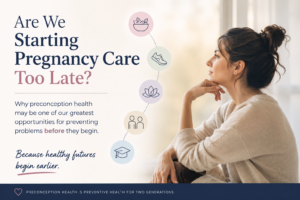
Are we starting pregnancy care too late?
We devote enormous attention and resources to pregnancy once it has begun. We monitor blood pressure and fetal growth. We screen for diabetes. We recommend supplements. We discuss nutrition, medications and lifestyle. We perform ultrasounds and carefully watch the development of the baby.
All of this is important.
But by the time we see that positive pregnancy test, some of the most important opportunities to influence the health of a pregnancy may already have passed.
Pregnancy health begins before pregnancy
One of the central messages of my book, Optimize Your Fertility Naturally, is that preparing for pregnancy should begin before conception.
Nutrition matters.
Metabolic health matters.
Sleep and exercise matter.
Environmental exposures matter.
The medications and supplements we take matter.
And the health of the father matters too.
We now understand that sperm health is influenced by many of the same factors that affect a woman’s reproductive health.
Yet our health-care system still tends to become most actively involved at one of two points: after pregnancy has occurred or after someone has difficulty becoming pregnant.
What if there were another opportunity?
What if preconception health became preventive health?
I have been thinking increasingly about what would happen if we stopped viewing preconception care simply as something people seek immediately before trying to conceive.
What if we viewed reproductive health as part of lifelong preventive health?
A young woman may not be planning a pregnancy for another five or ten years, but understanding her menstrual cycle, reproductive aging and conditions such as PCOS and endometriosis could affect decisions she makes today.
A young man may not be thinking about fatherhood, but understanding that smoking, metabolic health, environmental exposures and lifestyle can affect sperm health could influence choices he makes years before starting a family.
And improving those things isn’t only about fertility.
Better nutrition, physical activity, sleep and metabolic health potentially benefit the individual regardless of whether or when they eventually become a parent.
That is why I have begun thinking about preconception health as something much larger than fertility.
It may be preventive health for two generations.
Are we giving young people enough information?
This has also made me think about what we teach our children.
We appropriately spend a great deal of time teaching young people how to prevent unintended pregnancy and sexually transmitted infections.
But how much do we teach them about their future fertility?
Do young people understand how fertility changes with age?
Do they know what ovulation actually is?
Do boys learn anything meaningful about sperm health?
Do young women know enough about PCOS and endometriosis to recognize when something may not be normal?
Do they understand that some of the health choices they make today could potentially affect their reproductive health years from now?
This isn’t about encouraging young people to have children earlier.
Quite the opposite.
It is about giving them enough information to make informed choices about their futures.
I think there is a bigger conversation to be had
Writing Optimize Your Fertility Naturally began as an attempt to give individuals practical, evidence-based information they could use to improve their reproductive health.
But writing the book — and the conversations I have had since — have made me think increasingly about the bigger picture.
What would happen if we moved some of our attention upstream?
Could we identify reproductive-health problems earlier?
Could we provide better fertility education?
Could we include men much more meaningfully in preconception health?
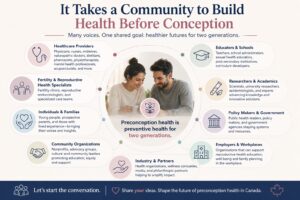
Could family physicians, obstetrician-gynecologists, fertility specialists, midwives, nurses, dietitians, pharmacists, naturopathic doctors, educators, researchers and other professionals work more closely together?
And could Canada ultimately develop a more coordinated approach to health before pregnancy?
I don’t have all the answers.
And I don’t think any one profession should.
But I believe the question is worth asking.
Over the next few weeks, I want to explore this
I’m going to use this blog to think through what better preconception care could look like.
I want to look at what Canada is already doing well, where the gaps may be, what other countries are doing, what role fertility education in schools might play, and whether there is an opportunity to bring together the many people already working in this area.
Most importantly, I want to hear from you.
For now, I’m not asking anyone to join an organization or endorse a proposal.
I’m simply asking you to think about one question:
If we could rethink preconception health from the ground up, what would you change?
If you have thoughts, please leave them in the comments.
Next week, I’ll share some of my ideas about what a more coordinated approach could look like — and some of the ideas I have already found particularly interesting.
For decades, we have concentrated enormous resources on caring for pregnancy.
Perhaps it is time to ask what more we could do way before pregnancy begins.
Dr Marina OBGYN