
By Dr. Marina Straszak-Suri, MD, FRCSC
If you’ve spent any time on social media recently, you’ve probably come across stories of women becoming unexpectedly pregnant after starting Ozempic®, Wegovy®, Mounjaro®, or Zepbound®. Some have even coined the phrase “Ozempic babies.”
As an obstetrician-gynecologist who has spent more than 35 years helping couples build their families, I understand why these stories have captured so much attention. Infertility affects millions of couples worldwide, and any treatment that appears to improve fertility naturally generates excitement.
But do these medications actually improve fertility?
The answer is yes—but probably not for the reason many people think.
Fertility Is a Reflection of Health
One of the central messages throughout my book, Optimize Your Fertility Naturally, is that fertility is a vital sign.
Just as high blood pressure tells us something about cardiovascular health, fertility tells us something about the body’s overall metabolic health.
Reproduction is an extraordinary biological process. It requires communication among the brain, ovaries, thyroid, adrenal glands, immune system, gut microbiome, and countless metabolic pathways. When these systems are functioning optimally, fertility often follows.
When they are not, the reproductive system is frequently one of the first to show signs of imbalance.
That is why I have always believed that treating infertility should involve far more than simply stimulating the ovaries.

A Better Name: PMOS
Throughout this article I will use the term Polymetabolic Ovary Syndrome (PMOS) rather than the traditional name polycystic ovary syndrome (PCOS).
The published medical literature still uses the term PCOS, so you will see that name in the scientific references. However, I believe PMOS better reflects what this condition truly is.
Most women with this syndrome do not develop ovarian cysts. What they do have is a complex metabolic disorder involving insulin resistance, chronic low-grade inflammation, hormonal imbalance, altered ovarian function, and frequently—but not always—excess body weight.
The name PMOS reminds us that this is far more than an ovarian disorder.
It is a metabolic condition that happens to affect the ovaries.
That distinction becomes particularly important when discussing GLP-1 medications.
What Are GLP-1 Medications?
GLP-1 receptor agonists include medications such as:
- semaglutide (Ozempic®, Wegovy®)
- liraglutide (Saxenda®, Victoza®)
- tirzepatide (Mounjaro®, Zepbound®), a dual GIP/GLP-1 agonist
These medications were originally developed to treat type 2 diabetes.
Researchers soon discovered something remarkable.
Patients not only experienced improved blood sugar control but also reduced appetite, significant weight loss, improved insulin sensitivity, lower inflammatory markers, healthier blood pressure, and improvements in fatty liver disease, cardiovascular risk, and sleep apnea.
In other words, these drugs improve the body’s metabolic environment.
And metabolism and reproduction are intimately connected.
Why Metabolism Matters for Fertility
Many people think of fertility as simply an issue of eggs and sperm.
In reality, successful reproduction depends on much more.
Healthy ovulation requires the brain, pituitary gland, ovaries, liver, pancreas, thyroid, adrenal glands, immune system, and even skeletal muscle to communicate efficiently.
One of the most important players in this conversation is insulin.
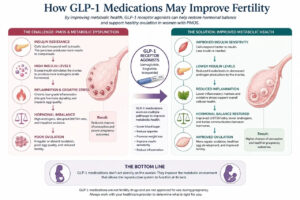
When insulin levels remain chronically elevated—as they often do in women with PMOS—the ovaries respond by producing excess testosterone. Follicles stop developing normally, ovulation becomes irregular, and menstrual cycles lengthen or disappear altogether.
This explains why insulin resistance is one of the major drivers of infertility in PMOS.
By lowering insulin levels and improving insulin sensitivity, GLP-1 medications may help restore this delicate hormonal communication.
Notice that I said may.
These medications are not forcing the ovaries to ovulate.
Instead, they appear to remove some of the metabolic obstacles preventing normal ovarian function.
That is a very different mechanism.
What Does the Research Actually Show?
The excitement surrounding GLP-1 medications is understandable, but it is important to separate scientific evidence from social media anecdotes.
The strongest evidence currently comes from women with obesity and PMOS.
Several recent systematic reviews have consistently demonstrated that GLP-1 receptor agonists improve:
- body weight
- waist circumference
- insulin resistance
- fasting insulin levels
- androgen excess
- menstrual regularity
- ovulatory function
Some studies have also reported higher natural pregnancy rates compared with conventional therapy, although these studies have generally been small and were not designed primarily to evaluate live birth outcomes. Current evidence is encouraging but not yet definitive.¹–³
This is an important distinction.
Improved ovulation does not automatically translate into improved live birth rates.
That is why larger randomized clinical trials are now underway.
Could GLP-1 Medications Improve Egg Quality?
Patients ask me this question almost every week.
Unfortunately, no one knows for certain.
Animal studies suggest that GLP-1 receptors are present within ovarian tissue, raising the possibility that these medications may reduce oxidative stress, improve mitochondrial function, decrease inflammation, and support healthier follicular development.
These are exciting possibilities.
However, we still lack convincing human studies demonstrating improved egg quality, embryo quality, implantation rates, or higher live birth rates independent of the improvements seen with weight loss and better metabolic health.
In medicine, biological plausibility is not the same as clinical proof.
This is one of the questions future research must answer.
Why I Find This Research So Encouraging
For decades, fertility treatment has focused primarily on helping women become pregnant.
That is, of course, our goal.
But perhaps we should ask an even more fundamental question:
How can we make women healthier before they conceive?
Healthy mothers are more likely to produce healthy eggs.
Healthier eggs are more likely to produce healthy embryos.
Healthier embryos are more likely to produce healthy pregnancies.
This way of thinking shifts our focus from treating infertility to optimizing health before conception.
That philosophy has guided my practice for many years.
GLP-1 medications do not replace lifestyle medicine.
Rather, in carefully selected patients, they may become another tool that helps us create the healthiest possible environment for reproduction.
Should You Take a GLP-1 Medication If You Are Trying to Conceive?
This is probably the question I am asked most often.
The answer depends entirely on why you are having difficulty conceiving.
If you have PMOS, obesity, insulin resistance, prediabetes, or type 2 diabetes, improving your metabolic health before pregnancy may significantly improve your reproductive health. In these women, GLP-1 medications can be an excellent addition to a comprehensive preconception plan.
However, if you are a healthy woman with regular ovulation and a normal body weight, there is currently no evidence that GLP-1 medications will improve your fertility.
Like every treatment in medicine, the right therapy depends on the right patient.
GLP-1 Medications Are Not Fertility Drugs
One of the biggest misconceptions on social media is that GLP-1 medications somehow stimulate the ovaries.
They do not.
Unlike medications such as letrozole or clomiphene citrate, which are designed to induce ovulation, GLP-1 receptor agonists improve the body’s metabolic environment. In women whose ovulation has been disrupted by insulin resistance and metabolic dysfunction, normal ovulation may return as the body becomes healthier.
This distinction is important because it changes how we think about treatment.
Rather than asking, “How can I make the ovary work harder?” perhaps we should first ask, “How can I make the body healthier?”
Often, the ovary simply responds to that healthier environment.
Timing Matters
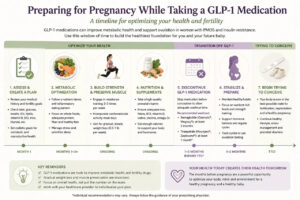
If GLP-1 medications improve metabolic health, should you simply continue taking them while trying to conceive?
At this point, the answer is no.
Current recommendations advise discontinuing GLP-1 receptor agonists before pregnancy because there is still insufficient evidence regarding their safety during fetal development. Animal studies have shown adverse fetal effects at high exposures, and although human data are becoming increasingly reassuring, they are not yet strong enough to change current recommendations.⁴⁻⁶
Because semaglutide remains in the body for a prolonged period, the manufacturer recommends stopping it at least two months before attempting conception. Tirzepatide clears more quickly, and current product information generally recommends stopping it at least one month before conception, although recommendations may vary by country and product label.⁵,⁶
I view this as an opportunity rather than a limitation.
The months before pregnancy are among the most important months in a baby’s life.
The egg that will eventually be ovulated has been developing for months before conception. Sperm are produced over approximately seventy to ninety days. This gives us a valuable window during which we can improve nutrition, metabolic health, sleep, physical fitness, and environmental exposures before fertilization ever occurs.
That is precisely what preconception care is all about.
Don’t Forget Nutrition
One concern that receives far less attention than it deserves is nutrition.
Rapid weight loss can sometimes reduce not only body fat but also muscle mass. Some people consume dramatically less protein because they simply are not hungry. Others develop deficiencies in iron, vitamin B12, folate, vitamin D, or other nutrients if they are not paying close attention to the quality of their diet.
These nutrients are essential for fertility.
Healthy eggs require healthy mitochondria.
Healthy embryos require adequate vitamins, minerals, amino acids, and antioxidants.
Pregnancy places enormous nutritional demands on a woman’s body, and the healthiest pregnancies begin long before conception.
For this reason, I encourage women taking GLP-1 medications to focus on:
- eating adequate protein at every meal
- maintaining resistance exercise to preserve muscle mass
- correcting nutritional deficiencies
- following a Mediterranean-style eating pattern rich in colourful vegetables, healthy fats, legumes, nuts, seafood, and high-quality protein
- avoiding ultra-processed foods
- taking an appropriate prenatal vitamin before conception
Weight loss alone is not the goal.
Metabolic health is.
What About Men?
For years, fertility research has focused primarily on women.
Fortunately, that is beginning to change.
Male factors contribute to infertility in nearly half of infertile couples, yet men’s metabolic health often receives surprisingly little attention.
Obesity is associated with lower testosterone levels, increased inflammation, oxidative stress, erectile dysfunction, poorer sperm quality, and increased sperm DNA damage.
Recent research has produced some encouraging findings.
In one randomized clinical study involving men with obesity, type 2 diabetes, and functional hypogonadism, semaglutide treatment improved testosterone levels and increased the proportion of morphologically normal sperm.⁷ Other early studies suggest improvements in sperm concentration and overall reproductive hormone profiles may also occur as metabolic health improves, although larger studies are still needed before firm conclusions can be drawn.⁸
This is particularly exciting because traditional testosterone replacement therapy often suppresses sperm production.
Improving a man’s own metabolic health may allow testosterone levels to recover naturally without compromising fertility.
As I often remind couples, fertility is not just a woman’s responsibility.
Healthy pregnancies begin with healthy mothers and healthy fathers.
What About the “Ozempic Baby” Phenomenon?
There is no question that more women are becoming pregnant unexpectedly after starting GLP-1 medications.
That does not necessarily mean the medication itself is increasing fertility directly.
Many women with PMOS who had irregular or absent ovulation begin ovulating more consistently after losing weight and improving insulin resistance.
Some women assume they are still infertile because they have struggled to conceive for years.
Others may not realize that tirzepatide can reduce the absorption of oral contraceptive pills during dose escalation, potentially decreasing contraceptive effectiveness if additional contraception is not used according to prescribing recommendations.⁶
The result is exactly what we have been seeing in clinics around the world—planned pregnancies, but also quite a few unexpected ones.
For many couples, that is wonderful news.
It also reminds us that fertility can improve much sooner than people expect when metabolic health begins to recover.
My Perspective After More Than Three Decades
After caring for thousands of women, I have become convinced that fertility medicine is gradually changing.
For many years, our emphasis was almost entirely on helping women become pregnant.
Today, we are increasingly recognizing that our greatest opportunity may lie in helping women become healthier before pregnancy.
GLP-1 medications represent an exciting advance in metabolic medicine.
They may become an important part of preconception care for carefully selected patients.
But they are not a substitute for healthy eating.
They are not a substitute for physical activity.
They are not a substitute for adequate sleep, stress reduction, correction of nutritional deficiencies, or minimizing environmental toxins.
Most importantly, they are not a substitute for individualized medical care.
Every woman deserves a comprehensive fertility assessment that looks beyond the ovaries and asks a broader question:
What is preventing this woman’s body from functioning at its very best?
When we answer that question thoughtfully and systematically, we do far more than improve fertility.
We improve lifelong health.
And that may be the greatest gift we can offer the next generation.
References
- Forslund, Maria, Peter Wändell, Lars Forsberg, Maria Österberg, Johan Dagerhamn, and colleagues. “GLP-1 Receptor Agonist Treatment in Women with Polycystic Ovary Syndrome: A Systematic Review and Meta-analysis.” European Journal of Endocrinology 194, no. 3 (2026): 25–39. https://doi.org/10.1093/ejendo/lvag033.
- Lin, S., Y. Deng, J. Huang, et al. “The Efficacy and Safety of GLP-1 Receptor Agonists on Weight Management and Hormonal and Metabolic Parameters in Women with Polycystic Ovary Syndrome: A Meta-analysis of Randomized Controlled Trials.” Scientific Reports 15 (2025): Article 99622. https://doi.org/10.1038/s41598-025-99622-4.
- Abedi, M. M., et al. “GLP-1 Receptor Agonists, Fertility Restoration, and Reproductive Safety in Women of Reproductive Age: A Narrative Review.” Journal of Clinical Medicine 15, no. 9 (2025): 3204. https://doi.org/10.3390/jcm15093204.
- Boots, Christina E., and Alyse S. Goldberg. “Medical Therapy to Optimize Fertility in Women with Obesity: The Emerging Role of GLP-1 Receptor Agonists.” Fertility and Sterility 124 (2024): 873–880.
- Druce, Ian. “GLP-1 Receptor Agonist Use in Pregnancy.” Canadian Diabetes and Endocrinology Today 3, no. 1 (2025).
- Novo Nordisk. Wegovy® (Semaglutide) Product Monograph. Mississauga, ON: Novo Nordisk Canada Inc., current edition.
- La Vignera, Sandro, et al. “Semaglutide Improved Sperm Morphology and Reproductive Hormones in Men with Obesity, Type 2 Diabetes and Functional Hypogonadism.” Andrology 13 (2024): 1468–1477.
- Voros, Csilla, et al. “A Systematic Review on GLP-1 Receptor Agonists in Polycystic Ovary Syndrome.” International Journal of Molecular Sciences 27, no. 2 (2026): 759.
- American Society for Reproductive Medicine. “Obesity and Reproduction: A Committee Opinion.” Fertility and Sterility. Current edition.
- Practice Committee of the American Society for Reproductive Medicine. “Optimizing Natural Fertility.” Fertility and Sterility. Current edition.
Dr Marina OBGYN