Beyond the Biological Clock: Eight Conversations About Fertility, Aging, and Longevity
Week 2 of 8 | Sunday, November 1, 2026
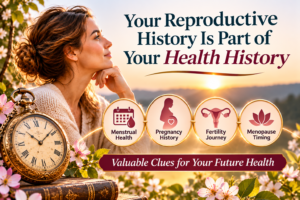
Could your reproductive history offer clues about your health decades into the future?
When we think about fertility, we usually think about the ability to conceive and have children.
But what if our reproductive health could tell us something much bigger?
What if the timing of our first menstrual period, difficulties conceiving, pregnancy complications, or the age at which we experience menopause could provide valuable information about our future cardiovascular health, metabolic health, and even longevity?
After more than 35 years practicing obstetrics and gynecology, I have come to believe that reproductive health deserves a much more prominent place in preventive medicine.
And increasingly, scientific research supports the importance of looking beyond reproduction itself.
Our Reproductive System Does Not Exist in Isolation
The reproductive system is intricately connected to nearly every other system in the body.
Hormones influence our metabolism, cardiovascular function, bone health, brain function, and immune system.
The ovaries are not simply organs that produce eggs. They are endocrine organs that participate in maintaining health throughout much of a woman’s life.
This is one reason researchers are becoming increasingly interested in the relationship between reproductive aging and biological aging.
One particularly intriguing observation is that women who experience menopause earlier tend to have higher rates of certain age-related health conditions.
But the relationship is complex.
Does earlier ovarian aging contribute to other health problems? Do shared biological processes influence both ovarian aging and overall health? Or might the relationship involve both mechanisms?
These are questions researchers are actively investigating.
1. Menopause Timing and Cardiovascular Health
One of the strongest areas of evidence connecting reproductive aging with future health concerns cardiovascular disease.
A major pooled analysis published in The Lancet Public Health examined data from more than 300,000 women.
Researchers found that women who experienced natural menopause before age 40 had approximately twice the risk of cardiovascular disease before age 60 compared with women whose menopause occurred between ages 50 and 51.¹
Women experiencing menopause between ages 40 and 44 also had an increased risk.
Importantly, these findings demonstrate an association. They do not establish that early menopause directly causes cardiovascular disease.
Nevertheless, they suggest that menopause timing is a potentially valuable piece of a woman’s cardiovascular risk assessment.
This is especially relevant because cardiovascular disease remains a leading cause of death among women worldwide.
We should not wait until a woman develops hypertension, diabetes, or coronary artery disease before discussing her long-term health.
Her reproductive history may already contain important clues.
2. Infertility and Future Cardiovascular Risk
Could a history of infertility itself be associated with future cardiovascular disease?
A large prospective study involving more than 100,000 women in the Nurses’ Health Study II examined this question.
Researchers reported that women who had experienced infertility had a modestly increased risk of coronary heart disease compared with women without a history of infertility.²
The association was particularly notable among women who reported infertility at younger ages.
However, infertility is not a single disease.
It can arise from ovulatory disorders, endometriosis, tubal disease, male factors, age-related changes, or unexplained causes.
Some underlying conditions may share risk factors or biological pathways with cardiovascular disease.
For example, polycystic ovary syndrome, increasingly discussed under the proposed name polycystic metabolic-ovarian syndrome (PMOS), is associated with insulin resistance and metabolic disturbances in many affected women.
Therefore, a history of infertility should not be interpreted as a prediction of future heart disease.
Instead, it may offer an opportunity to look more carefully at underlying health.
Infertility is not necessarily an isolated reproductive event. Sometimes it is a reason to examine the bigger picture.
3. Pregnancy as a Window into Future Health
Pregnancy provides another fascinating example of how reproductive events can reveal long-term health risks.
During pregnancy, the cardiovascular, metabolic, and endocrine systems undergo remarkable adaptations.
For some women, pregnancy acts almost like a physiological stress test.
Conditions such as preeclampsia and gestational diabetes may identify women who are more likely to develop cardiovascular or metabolic disease later in life.
A systematic review and meta-analysis published in the BMJ found that women with a history of preeclampsia had approximately twice the subsequent risk of ischemic heart disease compared with women without that history.³
Similarly, research has demonstrated that women with gestational diabetes have a substantially increased risk of developing type 2 diabetes later in life.⁴
These findings have important implications for preventive care.
A woman who experienced preeclampsia or gestational diabetes should not consider these conditions simply resolved once her baby is born.
Her pregnancy history deserves a permanent place in her medical record and future health assessments.
4. Does Reproductive Longevity Predict Overall Longevity?
One of the most intriguing questions is whether women who maintain reproductive function longer also tend to live longer.
In a study from the Women’s Health Initiative published in Menopause, researchers examined reproductive characteristics and survival to age 90 among more than 16,000 women.
They found that women whose natural menopause occurred at age 50 or later had greater odds of surviving to age 90 than women who experienced menopause before age 40.⁵
A longer reproductive lifespan was also associated with increased odds of exceptional longevity.
Does this mean that delaying menopause will make women live longer?
Not necessarily.
Women who experience later menopause may differ in genetics, lifestyle, health status, or other characteristics that also influence longevity.
The study was observational, and we cannot assume that extending ovarian function would automatically extend lifespan.
But it raises an important scientific possibility:
Reproductive aging may be one reflection of broader processes influencing how we age.
5. What About Men?
When discussing the biological clock, we often focus almost exclusively on women.
Yet male reproductive health also deserves attention.
Sperm production continues throughout much of adult life, but sperm quality, reproductive hormones, and reproductive outcomes can change with advancing age.
Importantly, male infertility may sometimes be associated with broader health concerns.
A study published in Fertility and Sterility examined mortality among more than 11,000 men evaluated for infertility.
Men with poorer semen parameters had higher subsequent mortality rates, although the observational findings could not establish causation.⁶
These findings suggest that semen quality may sometimes reflect aspects of overall health.
However, semen analysis is not a validated test of biological age or a tool for predicting an individual’s lifespan.
Still, the broader message is important.
Reproductive health is not exclusively a women’s health issue.
Both partners deserve attention when discussing fertility and long-term wellness.
6. What Should We Do With This Information?
We cannot change our reproductive history.
But we can change how we use it.
Imagine if every adult’s preventive health assessment included a thoughtful discussion of reproductive history.
For women, this could include menstrual patterns, infertility, pregnancy complications, and menopause timing.
For men, it might include fertility concerns, sexual and hormonal health, and relevant metabolic risk factors.
These conversations could help identify people who would benefit from earlier assessment of blood pressure, cholesterol, blood glucose, lifestyle factors, or other appropriate health measures.
They could also encourage better coordination between reproductive specialists, primary care providers, cardiologists, and other clinicians.
Of course, not every reproductive condition is a marker of future disease, and reproductive history cannot replace established screening and risk-assessment tools.
But it may add valuable context.
A Different Way to Think About Fertility
For decades, we have largely approached fertility as a question of whether someone can become pregnant.
I believe we need to broaden that perspective.
Reproductive health is part of lifelong health.
Understanding it earlier may help people make informed decisions about family building while also encouraging attention to cardiovascular, metabolic, and overall well-being.
This is one of the central messages of my book, Optimize Your Fertility Naturally: A Holistic Guide to Achieving a Healthy Pregnancy.
And it is a theme I will explore further when I speak at LongevityFest 2026 in Las Vegas this December.
The emerging science of reproductive longevity is opening new possibilities for understanding the relationship between fertility and aging.
We must be careful not to promise more than the evidence supports.
But we should also recognize the opportunity in front of us.
Perhaps the most important question is no longer simply, “Can I conceive?” but also, “What can my reproductive health teach me about my future well-being?”
Our reproductive history is part of our health history.
It’s time we started treating it that way.
Coming Next Sunday
PCOS, Endometriosis, and the Bigger Health Picture
Can common reproductive conditions tell us something about metabolic health, inflammation, and long-term disease risk?
Next week, we’ll explore why these conditions deserve attention long after—or even when—pregnancy is no longer a goal.
Join me each Sunday for Beyond the Biological Clock: Eight Conversations About Fertility, Aging, and Longevity, leading up to my presentation at LongevityFest 2026.
Dr Marina OBGYN
References
1. Dongshan Zhu et al., “Age at Natural Menopause and Risk of Incident Cardiovascular Disease: A Pooled Analysis of Individual Patient Data,” The Lancet Public Health 4, no. 11 (2019): e553–64. https://doi.org/10.1016/S2468-2667(19)30155-0.
2. Leslie V. Farland et al., “Infertility and Risk of Cardiovascular Disease: A Prospective Cohort Study,” Journal of the American Heart Association 12, no. 5 (2023): e027755. https://doi.org/10.1161/JAHA.122.027755.
3. Leanne Bellamy et al., “Pre-eclampsia and Risk of Cardiovascular Disease and Cancer in Later Life: Systematic Review and Meta-analysis,” BMJ 335, no. 7627 (2007): 974. https://doi.org/10.1136/bmj.39335.385301.BE.
5. Aladdin H. Shadyab et al., “Ages at Menarche and Menopause and Reproductive Lifespan as Predictors of Exceptional Longevity in Women: The Women’s Health Initiative,” Menopause 24, no. 1 (2017): 35–44. https://doi.org/10.1097/GME.0000000000000710.
6. Michael L. Eisenberg et al., “Semen Quality, Infertility and Mortality in the USA,” Human Reproduction 29, no. 7 (2014): 1567–74. https://doi.org/10.1093/humrep/deu106.