What if your reproductive health could tell you something about how you’re aging?
We all know our chronological age. It’s the number of candles on our birthday cake, the years since we were born, and the age recorded in our medical charts.
But what if I told you that your chronological age doesn’t necessarily reflect how quickly your body is aging?
Two people born in the same year may have very different biological ages. One may have excellent metabolic health, strong cardiovascular function, and relatively few signs of age-related disease. The other may already be experiencing conditions we typically associate with later life.
Scientists are increasingly interested in understanding why.
And as an obstetrician-gynecologist who has spent more than 35 years caring for women, I believe there is another important piece of this puzzle that deserves much more attention:
Our reproductive health.
Chronological Age Versus Biological Age
Chronological age tells us how long we have lived. Biological age attempts to describe how our bodies function and how aging-related changes progress.
Researchers are developing increasingly sophisticated ways to measure biological aging, including examining chemical modifications to DNA, known as epigenetic changes.
One important study, published in Genome Biology, demonstrated that patterns of DNA methylation could be used to estimate age across multiple human tissues.¹
Subsequent research has explored whether biological aging measurements can help predict future health outcomes, including mortality risk.²
These discoveries have generated tremendous excitement in longevity medicine.
However, biological age is not a single universally agreed-upon measurement. Different aging clocks measure different biological processes, and we are still learning how best to interpret them in clinical practice.
Nevertheless, they are changing the way we think about aging.
Instead of simply asking, “How old are you?” we are beginning to ask, “How well are you aging?”
The Reproductive Clock: A Different Kind of Clock
Most women have heard the expression “biological clock.”
Unfortunately, it is usually introduced in the context of declining fertility, often when a woman is already in her thirties or struggling to conceive.
But reproductive aging is much more complex than a countdown to menopause.
Women are born with a finite population of oocytes, which decline in both number and reproductive potential with advancing age.
Unlike many other organ systems, the ovaries undergo substantial age-related functional decline relatively early in life.
A woman’s reproductive lifespan generally ends decades before her overall lifespan.
This raises an intriguing question:
Could reproductive aging provide important clues about aging elsewhere in the body?
Research suggests that reproductive aging and general health are interconnected, although the precise biological relationships are still being investigated.
What Menopause May Tell Us About Long-Term Health
One particularly interesting area of research examines the relationship between the timing of menopause and future health.
In a large pooled analysis published in The Lancet Public Health, researchers examined data from more than 300,000 women and found that earlier natural menopause was associated with a higher risk of cardiovascular disease before age 60.³
Other studies have examined associations between menopause timing, longevity, and age-related disease.
This does not mean that menopause causes all these conditions, or that delaying menopause would necessarily prevent them.
Rather, it suggests that reproductive aging may reflect broader biological processes that influence long-term health.
That distinction is important.
In medicine, identifying an association is often the beginning of a scientific investigation, not the end.
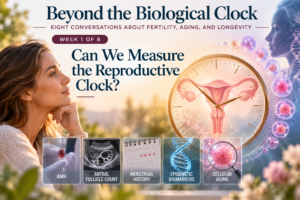
Can We Measure the Reproductive Clock?
In clinical practice, we already have tools that provide information about ovarian function and reproductive potential.
These include anti-Müllerian hormone (AMH), antral follicle count, menstrual history, and other clinical assessments.
However, none of these provides a complete measurement of reproductive biological age.
For example, AMH can help estimate ovarian reserve and predict ovarian response during fertility treatment, but it cannot reliably predict an individual woman’s ability to conceive naturally or exactly when she will reach menopause.⁴
Scientists are now investigating additional approaches, including epigenetic measurements, molecular biomarkers, and changes in ovarian cells and their surrounding environment.
These are promising areas of research, but most are not yet ready to guide routine clinical decisions.
We need to be careful not to confuse exciting scientific discoveries with proven clinical interventions.
Does Lifestyle Influence Reproductive Aging?
This is where the conversation becomes particularly relevant to people planning their future health.
We know that smoking is associated with earlier menopause.⁵
We also know that metabolic health, nutrition, physical activity, sleep, and environmental exposures can influence reproductive function and overall health.
But there is an important distinction between improving reproductive health and actually slowing the underlying biological process of ovarian aging.
At present, we do not have convincing clinical evidence that a particular diet, supplement, or lifestyle intervention can reliably reset the human reproductive clock.
That doesn’t mean we are powerless.
It means we should focus on what the evidence supports: improving health before pregnancy, identifying reproductive concerns earlier, reducing modifiable risks, and making informed decisions while more research continues.
We may not yet know how to turn back the reproductive clock, but we can be proactive long before infertility becomes a diagnosis.
Why This Conversation Matters to Me
After more than three decades practicing obstetrics and gynecology, I have met countless women who wished they had understood their reproductive health earlier.
Many were highly educated, successful professionals who had carefully planned their careers, finances, and relationships.
Yet they had received surprisingly little education about their reproductive lifespan.
We routinely encourage people to monitor their blood pressure, cholesterol, blood glucose, and cardiovascular risk.
Why don’t we give reproductive health the same attention?
And why do we so often wait until someone is actively trying to conceive before beginning the conversation?
I believe reproductive health deserves a place in preventive medicine, not simply infertility treatment.
This conviction inspired me to write Optimize Your Fertility Naturally: A Holistic Guide to Achieving a Healthy Pregnancy.
It is also central to the presentation I’ll deliver at LongevityFest 2026 in Las Vegas this December, where I will explore emerging connections between reproductive health, biological aging, and longevity.
A New Way to Think About Your Future Health
Whether you hope to have children someday, are currently trying to conceive, have completed your family, or are approaching menopause, reproductive health is part of your overall health story.
Understanding it may provide opportunities for earlier assessment, more informed choices, and better preventive care.
My message is not that we can stop the biological clock.
It is that we should stop ignoring it.
The future of longevity medicine should include reproductive health—and the conversation needs to begin much earlier.
Next Sunday: What Your Fertility May Reveal About Your Future Health.
Over the next eight weeks, I will explore the fascinating connections between fertility, reproductive aging, and longevity as I prepare for LongevityFest 2026.
I invite you to join me for this journey.
Dr Marina OBGYN
References
- Steve Horvath, “DNA Methylation Age of Human Tissues and Cell Types,” Genome Biology 14, no. 10 (2013): R115. https://doi.org/10.1186/gb-2013-14-10-r115.
- Morgan E. Levine et al., “An Epigenetic Biomarker of Aging for Lifespan and Healthspan,” Aging 10, no. 4 (2018): 573–91. https://doi.org/10.18632/aging.101414.
- Dongshan Zhu et al., “Age at Natural Menopause and Risk of Incident Cardiovascular Disease: A Pooled Analysis of Individual Patient Data,” The Lancet Public Health 4, no. 11 (2019): e553–64. https://doi.org/10.1016/S2468-2667(19)30155-0.
- Practice Committee of the American Society for Reproductive Medicine, “Testing and Interpreting Measures of Ovarian Reserve: A Committee Opinion,” Fertility and Sterility 114, no. 6 (2020): 1151–57. https://doi.org/10.1016/j.fertnstert.2020.09.134.
- Ellen B. Gold et al., “Factors Associated with Age at Natural Menopause in a Multiethnic Sample of Midlife Women,” American Journal of Epidemiology 153, no. 9 (2001): 865–74. https://doi.org/10.1093/aje/153.9.865.