
Beyond the Biological Clock: Eight Conversations About Fertility, Aging, and Longevity
Week 5 of 8 | Sunday, November 22, 2026
What if we could do more than measure our reproductive age? What if we could influence how quickly our reproductive system ages?
Last week, we explored the fascinating science of reproductive clocks, including anti-Müllerian hormone (AMH), antral follicle counts, and emerging epigenetic biomarkers.
We learned that although we can measure certain aspects of ovarian reserve, we still cannot reliably predict how many fertile years an individual woman has remaining.
But this raises an even more intriguing question.
Can we actually slow the reproductive clock?
For decades, reproductive aging was considered largely inevitable, governed primarily by chronological age and genetics.
Today, researchers are exploring the roles of mitochondrial function, oxidative stress, inflammation, metabolism, and cellular repair mechanisms in ovarian aging.
Some of these discoveries are reshaping our understanding of reproductive biology.
Others are generating considerable excitement—and sometimes unrealistic promises.
As an obstetrician-gynecologist with more than 35 years of experience, I believe this is one of the most exciting frontiers in reproductive medicine.
But it is also an area where we must distinguish between promising science and proven clinical interventions.
1. Why Do Our Ovaries Age?
Women are born with a finite population of oocytes, which progressively declines throughout life.
By the time menopause occurs, the ovarian follicle population has been substantially depleted.
However, ovarian aging involves more than follicle loss.
The remaining oocytes also undergo biological changes that can affect their developmental competence.
These include alterations in chromosome segregation, mitochondrial function, cellular metabolism, DNA repair, and the surrounding ovarian environment.
A landmark review published in Cell described how reproductive aging involves interconnected cellular processes rather than a single mechanism.¹
This distinction is important.
Even if an intervention could preserve the number of remaining follicles, it would not necessarily preserve egg quality.
And even if it improved certain cellular markers, that would not prove it could extend fertility.
To understand why, we need to look more closely at one of the most important structures inside the egg: the mitochondrion.
2. Mitochondria: The Energy Factories of Reproduction
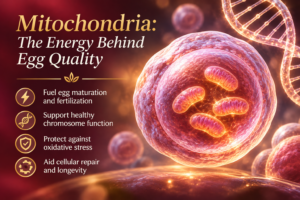
Mitochondria are often described as the energy-producing structures within our cells.
They generate adenosine triphosphate (ATP), the molecule that powers many essential cellular processes.
But mitochondria do much more than produce energy.
They also participate in cellular signaling, calcium regulation, metabolism, and responses to cellular stress.
Oocytes are particularly dependent on mitochondrial function.
During maturation, fertilization, and early embryonic development, the egg must coordinate complex processes requiring substantial energy.
As women age, changes in mitochondrial function may contribute to declining oocyte competence.
Research has identified associations between reproductive aging and altered mitochondrial activity, increased oxidative damage, and changes in cellular energy metabolism.¹
This has led researchers to investigate whether supporting mitochondrial function might help preserve reproductive potential.
The concept is appealing.
But here is the important distinction:
Improving mitochondrial function in an experimental model does not necessarily mean we can rejuvenate human eggs.
Much of the most exciting research remains preclinical.
3. NAD+, Cellular Energy, and Ovarian Aging
One of the most discussed molecules in longevity medicine is nicotinamide adenine dinucleotide, or NAD+.
NAD+ is essential for cellular energy metabolism and participates in pathways involved in DNA repair and cellular stress responses.
Its role in aging has attracted considerable scientific attention.
In 2020, researchers published a study in Cell Reports examining NAD+ metabolism and reproductive aging in mice.²
They found that treatment with the NAD+ precursor nicotinamide mononucleotide (NMN) improved several measures of oocyte quality and fertility in aged mice.
These findings were intriguing because they suggested that some age-related changes in reproductive function might be biologically modifiable.
But there is an important limitation.
Mice are not humans.
We cannot assume that an intervention improving reproductive outcomes in aged mice will have the same effect in women.
At present, there is insufficient clinical evidence that NMN, nicotinamide riboside, or other NAD+-boosting supplements improve human egg quality, increase live birth rates, or extend reproductive lifespan.
These interventions remain experimental in the context of reproductive longevity.
That does not make the research unimportant.
It means we need well-designed human trials before making clinical recommendations.
4. Oxidative Stress: Can We Protect Our Eggs?
Oxidative stress occurs when the production of reactive oxygen species exceeds the body’s ability to manage them through antioxidant and repair systems.
Reactive oxygen species are not inherently harmful. They also participate in normal cellular signaling.
However, excessive oxidative stress may damage cellular proteins, lipids, and DNA.
In reproductive tissues, oxidative stress has been implicated in age-related changes in oocyte function.
This has led to considerable interest in antioxidants, including coenzyme Q10 (CoQ10), vitamins C and E, and other compounds.
CoQ10 is particularly interesting because of its role in mitochondrial electron transport.
A randomized controlled trial published in Reproductive Biology and Endocrinology investigated CoQ10 pretreatment in younger women with diminished ovarian reserve undergoing IVF.³
The researchers reported improvements in certain ovarian stimulation and embryological outcomes.
However, the study was not adequately powered to demonstrate a definitive improvement in live birth rates.
This is a critical distinction.
Producing more eggs or improving laboratory measurements does not automatically translate into more healthy babies.
We need to evaluate interventions using outcomes that matter most to patients, particularly live birth rates and safety.
CoQ10 may be promising in selected fertility-treatment settings, but it has not been proven to reverse ovarian aging.
5. Nutrition and the Reproductive Clock
Nutrition is one of the areas where I believe we have an important opportunity to improve reproductive health.
Our dietary patterns influence metabolic health, insulin sensitivity, inflammation, and nutrient availability.
All of these processes can affect reproductive function.
The Mediterranean dietary pattern has received particular attention because it emphasizes vegetables, fruits, legumes, whole grains, nuts, olive oil, and fish.
These foods provide fiber, unsaturated fats, vitamins, minerals, and a wide range of bioactive compounds.
A systematic review published in Human Reproduction Update examined dietary patterns and fertility outcomes.⁴
The researchers found that some dietary patterns were associated with improved reproductive outcomes, although findings varied considerably across studies.
Observational associations do not establish that a particular diet improves egg quality or delays menopause.
Nevertheless, nutrition is a modifiable component of overall health that deserves attention before conception.
In my book, Optimize Your Fertility Naturally, I emphasize preparing the body for pregnancy rather than waiting until fertility difficulties develop.
This includes addressing nutritional deficiencies, metabolic health, and lifestyle factors that may influence reproductive function.
But I also believe we must use language carefully.
A healthy diet can support reproductive health.
It has not been proven to stop or reverse ovarian aging.
6. Metabolic Health: An Often-Overlooked Connection
One of the most important links between reproductive health and longevity is metabolic function.
Insulin resistance, obesity, diabetes, and other metabolic disturbances can influence reproductive hormones and ovulatory function.
We discussed this in Week 3 when exploring polycystic ovary syndrome (PCOS).
For women with PCOS, lifestyle interventions that improve metabolic health may also improve menstrual regularity and ovulatory function.
However, restoring ovulation in someone with a metabolic or endocrine disorder is not the same as reversing age-related ovarian decline.
This distinction matters.
A woman with PCOS who begins ovulating regularly after improving her metabolic health may experience better reproductive function.
But this does not mean her ovaries have become biologically younger.
Similarly, addressing metabolic health before pregnancy may improve general health and reduce certain pregnancy-related risks without necessarily changing the age-related decline in oocyte quality.
These are still valuable outcomes.
We should not underestimate the importance of improving health simply because we cannot yet demonstrate an extension of reproductive lifespan.
7. Exercise, Sleep, and Stress: What Do We Know?
Regular physical activity is associated with numerous benefits, including improved cardiovascular health, insulin sensitivity, and metabolic function.
Adequate sleep also supports hormonal regulation and overall health.
Chronic stress can influence neuroendocrine pathways and may affect reproductive function under certain circumstances.
However, we should avoid suggesting that ordinary psychological stress is a proven cause of infertility.
The relationship between stress and fertility is complex, and findings across studies are inconsistent.
Similarly, there is insufficient evidence that exercise, better sleep, or stress-management techniques directly slow ovarian aging.
Excessive exercise, especially when paired with inadequate energy intake, can disrupt ovulation.
The goal is balance.
Rather than promising that lifestyle changes will turn back the reproductive clock, I encourage patients to focus on creating the healthiest possible environment for reproductive function.
That message is more realistic and scientifically defensible.
8. Can We Rejuvenate the Ovaries?
This is where reproductive longevity research becomes particularly fascinating.
Researchers are investigating approaches that may influence ovarian function, including platelet-rich plasma (PRP), stem-cell-based therapies, mitochondrial interventions, and drugs targeting cellular aging pathways.
Some studies have reported changes in hormone levels, ovarian reserve markers, or reproductive outcomes following experimental interventions.
However, many of these studies are small, uncontrolled, or methodologically limited.
For example, ovarian PRP has attracted considerable attention as a potential treatment for diminished ovarian reserve or premature ovarian insufficiency.
But evidence that it reliably improves live birth rates or restores fertility remains insufficient.
There are also unresolved questions about patient selection, procedural safety, treatment standardization, and long-term outcomes.
Similarly, stem-cell approaches remain investigational.
We should be especially cautious about commercial claims suggesting that these treatments can reliably reverse menopause or restore youthful ovarian function.
A treatment that changes an AMH level or menstrual pattern has not necessarily rejuvenated the ovary.
The ultimate goal should be safe, meaningful improvements in reproductive outcomes—not simply more favorable laboratory numbers.
9. What About Rapamycin and Other Longevity Drugs?
Another emerging area involves medications being investigated for their effects on aging-related pathways.
Rapamycin, which inhibits mechanistic target of rapamycin (mTOR) signaling, has attracted attention because of its effects on lifespan and cellular processes in experimental models.
mTOR signaling plays important roles in metabolism, growth, and ovarian follicle activation.
Researchers are exploring whether carefully modifying this pathway might influence ovarian aging.
However, rapamycin is not an established treatment for extending human fertility.
Its immunosuppressive effects, potential adverse reactions, and reproductive safety considerations make unsupervised use particularly concerning.
We need rigorous clinical trials to determine whether any reproductive benefits outweigh the risks.
The same caution applies to other compounds marketed as longevity interventions.
The biological plausibility of a treatment is not proof of clinical effectiveness.
10. What Can We Actually Do Today?
Although we cannot yet reliably stop the reproductive clock, there are meaningful steps people can take to support reproductive health.
These include:
- Avoiding smoking and exposure to tobacco smoke.
- Maintaining adequate nutrition and addressing identified deficiencies.
- Engaging in regular, balanced physical activity.
- Supporting metabolic health and managing conditions such as diabetes and PCOS.
- Prioritizing adequate sleep.
- Avoiding excessive alcohol consumption and recreational drugs.
- Reviewing medications and environmental exposures when planning pregnancy.
- Seeking timely fertility assessment when indicated.
- Considering fertility preservation when appropriate, particularly before gonadotoxic treatments.
Importantly, these measures are not guarantees of fertility.
Nor should they be used as a reason to delay childbearing based on the assumption that ovarian aging can be prevented.
Chronological age remains one of the strongest predictors of reproductive outcomes.
The most effective fertility strategy may sometimes be earlier education and timely decision-making rather than attempting to reverse aging later.
The Future of Reproductive Longevity
I believe we are entering an extraordinary period in reproductive medicine.
For the first time, researchers are investigating ovarian aging not simply as an unavoidable consequence of time, but as a biological process that may contain modifiable pathways.
The intersection of reproductive medicine, mitochondrial biology, genetics, and longevity science offers exciting possibilities.
But we must build the future on careful research.
We need studies that evaluate not only biomarkers and laboratory outcomes, but also pregnancy rates, live births, offspring health, and long-term safety.
As I prepare for my presentation at LongevityFest 2026 in Las Vegas, I am particularly interested in how reproductive aging research may contribute to our broader understanding of healthy aging.
After all, the ovary is not simply a reproductive organ.
It is also an endocrine organ whose function is intimately connected with women’s health across the lifespan.
Understanding ovarian aging may eventually help us better understand biological aging itself.
My Takeaway
I often remind patients that optimizing fertility is not the same as guaranteeing pregnancy.
We cannot control every aspect of reproductive aging.
But we can identify and address modifiable factors that affect reproductive health.
We can make informed decisions earlier.
And we can support research that may eventually lead to new ways of preserving reproductive function.
Perhaps the most important message is not that we can turn back the reproductive clock—but that we should not wait until it becomes a problem before paying attention to it.
That is the philosophy behind my book, Optimize Your Fertility Naturally: A Holistic Guide to Achieving a Healthy Pregnancy.
And it is a message I hope will become increasingly central to both reproductive medicine and longevity medicine.
Coming Next Sunday
The Male Reproductive Clock: Why Fertility and Longevity Are Not Just Women’s Issues
Men produce sperm throughout much of adult life, but that does not mean their reproductive systems remain unchanged with age.
Next week, we’ll explore paternal age, sperm DNA integrity, metabolic health, and the emerging connections between male reproductive health and longevity.
Join me each Sunday for Beyond the Biological Clock: Eight Conversations About Fertility, Aging, and Longevity, leading up to my presentation at LongevityFest 2026.
Dr. Marina OBGYN
Obstetrician-Gynecologist
Author of Optimize Your Fertility Naturally: A Holistic Guide to Achieving a Healthy Pregnancy
References
1. Maria Fotara et al., “Endocrine and Molecular Mechanisms of Oocyte Aging: From Gonadotropin Signaling to Metabolic and Microenvironmental Dysfunction,” Current Issues in Molecular Biology 48, no. 9 (2026): 959. https://doi.org/10.3390/cimb48090959.
2. Michael J. Bertoldo et al., “NAD+ Repletion Rescues Female Fertility during Reproductive Aging,” Cell Reports 30, no. 6 (2020): 1670–81.e7. https://doi.org/10.1016/j.celrep.2020.01.058.
3. Yangying Xu et al., “Pretreatment with Coenzyme Q10 Improves Ovarian Response and Embryo Quality in Low-Prognosis Young Women with Decreased Ovarian Reserve: A Randomized Controlled Trial,” Reproductive Biology and Endocrinology 16 (2018): 29. https://doi.org/10.1186/s12958-018-0343-0.
4. “Mediterranean Diet and Infertility: A Systematic Review with Meta-Analysis of Cohort Studies,” (2022). PubMed record. This reference is a relevant dietary review, but the full bibliographic details should be checked before publication.